

The past 12 months have witnessed unprecedented geopolitical disruptions via trade tensions and “hot” conflicts, continued bifurcation in oil trade — and in the pace of the energy transition — and renewed industry enthusiasm for the long-term prospects for oil and gas. As 2026 draws near, here are 10 of the biggest questions Energy Intelligence will be tracking in the new year.
Will Geopolitical Risks Continue Disrupting Oil Markets?
Geopolitics is the biggest wild card for oil markets in 2026, with three of the world’s largest producers — Russia, Iran and Venezuela, collectively accounting for 17% of global crude supply — facing either tightening or easing of sanctions in the next 12 months. De-escalation would free up significant additional supply and remove artificial barriers to trade flows, adding downward pressure on oil prices. Stalemate or escalation would further bifurcate markets, potentially curtail flows and keep a geopolitical risk premium in oil prices.
On Russia-Ukraine, two of Energy Intelligence’s three scenarios see the war continuing through 2026 — although a ceasefire, which the US Trump administration strongly desires, cannot be discounted. US and European energy sanctions are likely to tighten in our base case, with Ukraine drone strikes on Russian energy assets intensifying. It is unclear how rapidly Russia could increase output and exports if peace is achieved, but revenues would likely benefit from an end to sanctions-led price discounts and convoluted export logistics.
Lax US sanctions enforcement on Iranian exports is allowing flows to continue, albeit at even larger discounts than Russia. Here, still-high regional tensions threaten renewed conflict that could directly threaten Iranian oil flows — and those from other Mideast Gulf producers.
On Venezuela, our base scenario (35% probability) sees US increasing pressure on Venezuelan President Nicolas Maduro but refraining from delivering a knockout blow to Venezuela’s oil sector or Maduro’s hold on power. However, fallout from this week’s seizure of an oil tanker transporting Venezuelan crude should be watched closely given the raised prospects for a more significant ramp-up in tougher sanctions enforcement and tanker seizures/blockade-type action. Direct risks to Venezuelan oil infrastructure are unlikely across most scenarios; material increases in Venezuelan output following full resolution and regime change would likely require years due to underinvestment and neglect.
Will an Expected Surplus Really Pummel Oil Markets?
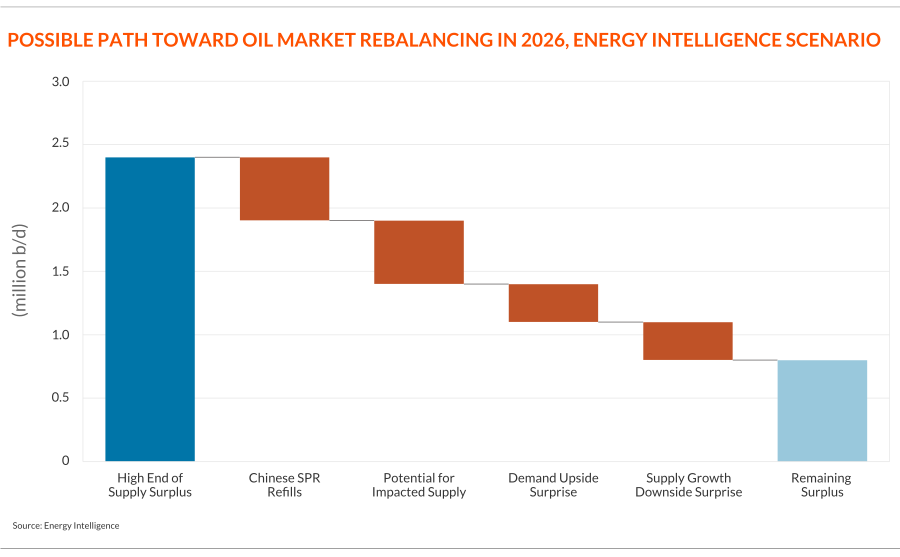
Consensus oil supply-demand forecasts, including those of Energy Intelligence, envisage a large global oil surplus of 1.5 million barrels per day or more building in 2026. But there is hardly consensus around how long and how deep such a surplus, if realized, would bite. While headline surplus levels of that magnitude would typically portend a lengthy rebalancing and recovery, oil industry executives have increasingly challenged the inevitability of deep pain lasting beyond 2026, due to ample inventory space and anticipated demand growth — with some seeing downward price pressure as largely a first-half event.
Energy Intelligence indeed sees a large oversupply as most likely to present itself in early 2026 during the seasonal demand lull, with benchmark Brent likely falling into the low $50s or below (geopolitical disruptions notwithstanding). Inventory builds, led by China’s massive ongoing strategic stockpiling, will be key to buffering the downside. Our forecasts see Chinese stockbuilds averaging 750,000 b/d in first-half 2026 and falling to 350,000 b/d in the second. Energy Intelligence is more cautious around global oil demand growth’s ability to materially step in to mop up excess supply, with year-on-year growth forecast at less than 1 million b/d — and only limited ability to rise further even if prices were to fall materially lower. The supply side will therefore likely lead any recalibration, in our view. Non-Opec plus volumes are expected to be the most price sensitive, with Opec-plus responding to market conditions as the year progresses.
Is AI’s Power Demand Surge Inevitable?
Artificial intelligence will continue to have a profound effect on the energy sector in 2026. Further clarity should emerge around whether AI will accelerate or decelerate the energy transition: While there is an obvious synergy between AI and smart, digital, electrified low-carbon technologies, AI’s power demand might also require more fossil fuels to remain part of the energy mix for longer.
Even if the latter proves true, massive upside for power demand from AI is not fait accompli. We see momentum building around a newly emerging, more sophisticated debate taking shape around AI’s expected power demand as evidence mounts that hardware and software efficiencies — and data center load management — will offset at least some of the technology’s thirst for power. That said, AI’s power needs are pronounced, and we expect electricity supply bottlenecks — gas turbine shortages, grid connection limitations, permitting delays and growing local opposition — to collectively pose a rising challenge next year to meeting this future demand. New work-arounds are emerging, but the US picture is murkier given the Trump administration’s opposition to renewables.
Specific to the oil and gas sector, 2026 should see further acceleration of the uptake of AI for business operations: Energy Intelligence’s new AI Tracker found that the first quarter of 2025 alone saw leading oil and gas firms announce more AI-related initiatives than across all of 2024.
Can US Shale Keep Surprising to the Upside?
US tight oil production, at 9.7 million b/d, is the market’s biggest slug of short-cycle supply — and thus a key variable in the market’s 2026 rebalancing equation. But total US crude output in 2025 has once again surprised to the upside, setting higher-than-expected records above 13.8 million b/d in the fourth quarter. While shale’s faster cycle times and relative price sensitivity — particularly in less-advantaged geologies or under the purview of less financially robust, smaller operators — will place the US on the front lines of a price-led supply response; expectations for year-on-year production declines risk being overstated, in our view.
Continued efficiency gains, optimized lateral lengths and innovation — including new proppants, CO2-based enhanced oil recovery and advanced completion techniques — will continue to allow operators to do more with fewer capital dollars, while consolidation has concentrated needle-moving supplies in the hands of cash-rich majors and E&Ps keen to maintain operational momentum.
Energy Intelligence expects US crude oil output to remain essentially flat on a year-on-year basis in 2026, at around 13.6 million b/d, thanks in large part to the strong momentum heading into next year; US production was up 660,000 b/d in December 2025 versus January 2025. However, price-led declines are forecast to push US production down more than 200,000 b/d at the exit of 2026 compared to their end-2025 levels.
Is Chinese Oil Demand Ready to Peak?
Waning demand for road transport fuels and a sputtering economic growth trajectory have put peak oil demand in China — the bedrock of global oil demand growth this century — on the table. China’s oil demand has quadrupled from 4 million b/d to 16 million b/d since it joined the World Trade Organization in 2001. But Energy Intelligence estimates growth is edging toward zero, with 2025 growth at just 235,000 b/d and an anemic 140,000 b/d for 2026. Diesel demand has already peaked, with gasoline set to follow next year due to the rapid rise of electric vehicles (EVs) and LNG-fueled trucks. Beijing has capped its domestic refining capacity at 20 million b/d in response; with the new 220,000 b/d Zhenhai and 300,000 b/d Panjin refineries soon to be commissioned, this capacity will be effectively reached by 2027.
Meanwhile, China’s crude imports — which Beijing has no intention of letting exceed 25% of global seaborne oil trade of around 80 million b/d — are no longer trending higher, even with massive stores heading into strategic stocks (barrels that fall outside supply-demand balances). Naphtha and LPG demand will still grow as a feedstock for petrochemicals, but capacity is both oversized and underutilized, weighing on margins globally. Weak domestic consumption and trade friction are key signposts to watch.
*Other includes naphtha and diesel used in integrated petrochemicals units, bitumen, lubricants, solvents, petroleum coke and possibly other products. Source: Energy Intelligence, China National Bureau of Statistics, General Administration of Customs
Mideast Conflict: Is ‘Round 2’ on the Way?
Israel-Iran tensions are not dominating current geopolitical headlines, but unfinished business between the two nations makes a second round of fighting an underappreciated risk, in our view. Iran is still thought to have its stockpile of near-weapons-grade uranium, it has retained its nuclear know-how, and it now has additional motivation for building a weapon for deterrence. Iran is also quietly rebuilding its ballistic missile arsenal, which did significant damage to Israel during the 12-day conflict in June. Israel’s current leadership is meanwhile ideologically committed to thwarting Iran’s nuclear ambitions and has demonstrated its ability to badly weaken its archenemy. Iran could seek to exact a higher price in any new round of direct conflict, including by targeting energy infrastructure.
US President Donald Trump has meanwhile positioned himself as a peacemaker in Gaza, claiming credit for progress toward permanent peace. But it is far from certain that the US will maintain the diplomatic pressure — particularly on Israel — required to keep the region calm. The Trump administration’s new national security strategy explicitly deprioritizes the Middle East, suggesting disengagement — but that also contrasts with its stated desire “to prevent an adversarial power from dominating the Middle East, its oil and gas supplies, and the chokepoints through which they pass.”
Will Resource Access Continue Trumping Risk for IOCs in the Mideast and Africa?
Strategic repositioning across Western international oil companies (IOCs) favoring “core” oil and gas businesses over aggressive low-carbon diversification has sparked renewed enthusiasm for big conventional oil and gas resources. Expectations for stronger-for-longer global demand, plateauing US shale production and higher underlying decline rates have IOCs and national oil companies alike champing at the bit for advantaged resource access.
Sweeter terms and less red tape on offer in key African provinces and the Mideast’s giant reserves, and low decline rates are proving too compelling to ignore — even in geopolitically “risky” regions. Upstream investment here is surging after a decade of underinvestment and could take another leap forward in 2026.
Exxon Mobil and Chevron may join TotalEnergies and BP in returning to Iraq. Both have reportedly been in talks over Lukoil’s lead stake in the giant 480,000 b/d West Qurna-2 field, in addition to other Iraqi upstream opportunities. The US majors may also finally ink long-touted deals to tap the massive shale gas potential of Algeria, where 2025’s first upstream bidding in a decade saw Total, Eni and QatarEnergy win big. Libya’s first bidding in 18 years is set for February award, with Exxon, Chevron and Shell all touted to return to the North African nation, joining Total, Eni and BP, who are already stepping up investment. Further south in Angola, Shell last month returned as operator after a 20-year absence, capping a surge in exploration investment off West Africa.
| IOCs Seek Positions in Top Plays | |||||||
| Firms Prioritize Most Advantaged Barrels in Exploration and Development | |||||||
| ‘Advantaged Barrel’ Attributes | Algeria | Egypt (Offshore) |
Libya | Iraq | Mideast Gulf |
Nigeria | Angola |
| Low Costs (opex and/or capex) | 🟨 | 🟨 | 🟨 | 🟩 | 🟩 | 🟨 | 🟨 |
| Short Development Cycles | 🟨 | 🟨 | 🟨 | 🟥 | 🟩 | 🟩 | 🟩 |
| Favorable Fiscal Terms | 🟨 | 🟨 | 🟨 | 🟥 | 🟨 | 🟨 | 🟨 |
| Lower Carbon Footprints | 🟥 | 🟨 | 🟥 | 🟥 | 🟩 | 🟨 | 🟨 |
| Access to Markets/ Infrastructure | 🟩 | 🟨 | 🟨 | 🟨 | 🟩 | 🟩 | 🟨 |
| Options for Integration | 🟩 | 🟨 | 🟨 | 🟨 | 🟩 | 🟩 | 🟩 |
| Low Aboveground Risk Exposure | 🟨 | 🟨 | 🟥 | 🟥 | 🟨 / 🟥 | 🟨 | 🟩 |
| Low Geopolitical Risk Exposure | 🟨 | 🟨 | 🟩 | 🟩 | 🟨 | 🟩 | 🟩 |
| Legend: 🟩 High Fit 🟨 Medium Fit 🟥 Low Fit | |||||||
| Source: Energy Intelligence | |||||||
Will the LNG Supply Wave Start to Hit Prices?
The long-awaited LNG supply wave is under way — even if not fully realized until 2029-30. Energy Intelligence sees both new volumes — via 62 million tons per year of capacity start-ups — and a weakening oil market weighing on spot and term LNG prices in 2026.
QatarEnergy will feature most prominently in next year’s additions via the imminent start-up of the 18 million ton/yr Golden Pass venture on the US Gulf Coast and the 32 million ton/yr North Field East (NFE), which is expected in the second half of 2026. At full capacity, Golden Pass is large enough to offset the EU’s Russian LNG imports, which it aims to phase out by end-2026. Roughly 25% of NFE is uncontracted, providing considerable flexible volumes into spot sales. Several smaller projects will round out supply.
Northeast Asian spot prices are forecast to drop below $10 per million Btu next year — compared to an average above $12/MMBtu in 2025 and a peak around $15/MMBtu — low enough to coax some price-sensitive regional spot buyers, led by Chinese firms, back to the market. But prices will still be too high for a more substantial demand response, which we expect will emerge in the following years as further supply waves break.
Can the LNG Market Handle More Final Investment Decisions (FIDs)?
This year was a bumper year for LNG FIDs, with roughly 63 million tons/yr of capacity given the green light, helped by years of work securing long-term offtake commitments, recent regulatory and legal tailwinds, and equity financing. These conditions will support further FIDs over the next few months — but with increasingly stiff competition among prospective projects as the market quickly reaches its expected fill.
Energy Intelligence categorizes projects with a combined 34 million tons/yr of liquefaction capacity as “probable” for FID before the end of 2026, with up to an additional 52 million tons/yr classified as “possible.” But among the pool of potential projects, at least 69 million tons/yr of ventures working toward near-term FID still require considerable firm offtake, while financing for an additional 48 million tons/yr remains questionable despite other enablers. Moreover, rising costs and declining prices — emblematic of the tail end of the development cycle — are supercharging an already competitive landscape in the absence of traditional project-financing alternatives.
Projects to watch include Eni’s Argentina LNG, along with Energy Transfer’s Lake Charles (US), Western LNG’s Ksi Lisims (Canada), Glenfarne’s Alaska LNG (US) and Exxon’s Rovuma (Mozambique). These large ventures, totaling almost 80 million tons/yr, reported key developments in 2025 but still have important commercial, financing and other milestones to reach before hitting FID.
Will Chinese Technology Supercharge the Energy Transition in the Global South?
Many headlines in the West suggest a slowing energy transition, but we caution against extrapolating headwinds globally. China upended expectations — and global markets — for solar power cost-competitiveness through technological advancement, unmatched economies of scale and build-out of enormous overcapacity across supply chains, making it the dominant global supplier of solar cells and panels. This template is playing out in other low-carbon sectors, with potentially similar disruptive impacts on market share and cost curves.
China’s EV industry is indeed already following a similar pattern, with Chinese EV exports helping deliver surprising uptake in emerging markets such as Turkey, Thailand and Vietnam, surpassing new vehicle sales rates of many developed countries. Soaring battery exports, combined with future advancements in cheaper battery chemistries such as sodium-ion, may lock in China’s EV advantage while pulling down grid-scale battery levelized costs of energy to record lows. Chinese-supplied solar battery projects could quickly emerge as the backbone of many power systems.
Lurking in the background are nuclear and hydrogen electrolyzers, for which enormous Chinese supply chains have been built out and costs are falling. However, while these technologies are set to scale even further domestically in 2026, it is not yet clear the extent to which they may yet upend global energy economics via exports. China’s nuclear ecosystem likely doesn’t have the excess capacity needed to support exports. And while there is overcapacity in China’s electrolyzer market, electrolyzers comprise only a modest part of the hydrogen cost equation, with electricity inputs by far the largest component.