
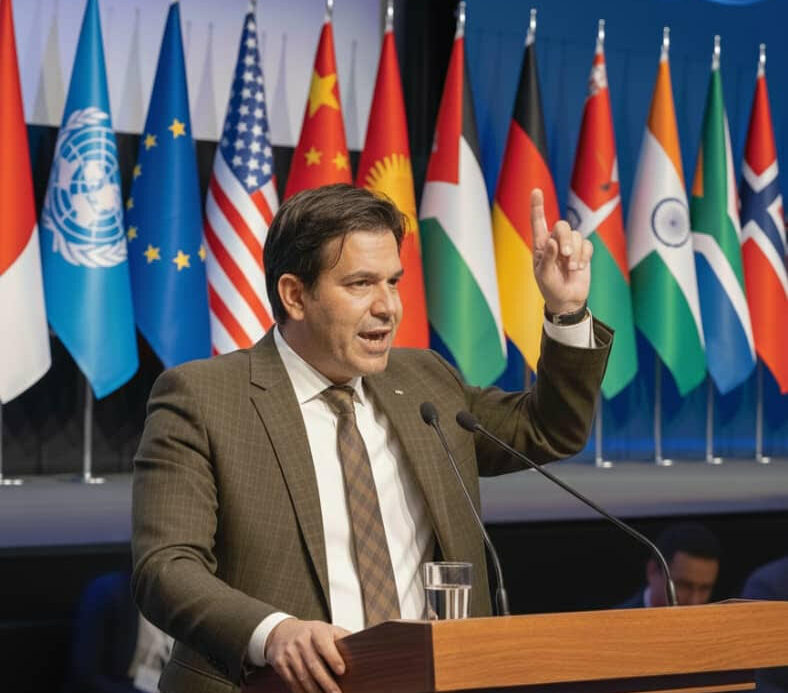
-Friendship with Saudi Arabia: A Choice or a Strategic Necessity?
Special Analysis on the Occasion of Mohammed bin Salman’s Visit to the United States
Saudi Arabia on the Verge of Redefining Its Regional Role — The Message of a Historic Visit
The recent visit of Mohammed bin Salman, the Crown Prince of Saudi Arabia, to the United States is not an ordinary event on the Middle East diplomatic calendar. It marks the beginning of a new phase in the region’s power dynamics—one in which Riyadh is transforming from a traditionally cautious actor into a central hub of geopolitical decision-making.
This visit raises the essential question currently dominating analytical circles:
Is friendship with Saudi Arabia merely an option—or an unavoidable strategic necessity?
The New Saudi Arabia: Far Beyond an Energy Producer
Over the past five years, Saudi Arabia has rebuilt its traditional power structure through massive economic projects such as Vision 2030, multi-billion-dollar investments, and a multi-layered foreign policy.
Today, Riyadh is no longer just an oil exporter;
it is an exporter of stability, capital, and political influence.
Key Features of Today’s Saudi Arabia:
A decisive actor within OPEC+
An energy partner for Europe, the U.S., and East Asia
A tactical ally to both China and the United States
A major investor across Africa, Asia, and emerging technologies
A confident, independent regional power
These transformations have dramatically increased Saudi Arabia’s political weight compared to the past.
The Message Behind MBS’s Visit to Washington: A Renewed Saudi–US Partnership
The Crown Prince’s meetings in Washington were far more than ceremonial.
They represent the revival of an upgraded version of the long-standing Saudi–American partnership.
The agenda included regional security, the future of global energy markets, technological cooperation, defense modernization, and major economic development projects.
Why is the U.S. returning to a closer partnership with Saudi Arabia?
The need for energy stability amid global crises
Concerns over China’s growing influence in the Middle East
The importance of Saudi Arabia in regional mediation
Efforts to maintain political balance in the Persian Gulf
In return, Saudi Arabia seeks:
Security guarantees
Access to advanced technologies
Expanded influence in global financial markets
Reinforcement of its position as the leading Arab power
Friendship with Saudi Arabia: Opportunity or Shared Responsibility?
In today’s regional environment, cooperation with Saudi Arabia is not simply a diplomatic option;
it is a geopolitical necessity.
A country with such economic capacity and leadership in the Arab world can serve as a stabilizing force across the region.
The significance of partnership with Saudi Arabia can be viewed from several perspectives:
Security: Reducing regional tensions and managing crises
Economic: Access to larger markets and powerful investors
Political: Strengthening regional voices in global decision-making
Energy: Coordinated efforts for fairness and stability in oil and petrochemical markets
Recent decades have shown that sustained cooperation among regional powers—particularly between Iran and Saudi Arabia—can pave the way for growth and security throughout the Middle East.
Conclusion: A New Era of Regional Relations Has Begun
Mohammed bin Salman’s visit to the United States carries a clear message:
The Middle East has entered a new era of balance and cooperation.
In this era, Saudi Arabia is not just another player; it is the foundation of the region’s emerging order.
Therefore, friendship with Saudi Arabia—economically, politically, and in terms of security—is less a matter of free choice and more a strategic necessity for the future of regional states.